Views: 0 Author: Adhaiwell Publish Time: 2026-09-18 Origin: Site
A scrolling poster display system is a motorized drive kit — motor, rollers and digital controller — that rotates up to six printed posters inside a single backlit light box. It is the hardware behind the multi-image poster panels you see on bus shelters, in station concourses and on city shopping streets: one cabinet, one light source, but a sequence of advertisements instead of a single static sheet. This article explains what the system consists of, how the scrolling cycle actually works, and which panel sizes each class of kit serves.
A scrolling poster display system is a motorized drive kit that rotates up to six printed posters inside a single backlit light box.
The working cycle is simple: two rollers carry a continuous poster loop, and a digital controller sets the speed, direction and dwell time of each poster.
Systems are sized by panel area — roughly 3 sqm for small city light boxes, 6–15 sqm for street furniture formats, up to 18 sqm for large frontage signs.
Compared with a static panel, the same advertising space sells six slots; compared with an LED screen, it costs a fraction as much and runs on 50–220 W.
The direct answer: four components — a drive motor, a roller set, a control board and a power supply — plus the poster loop itself.
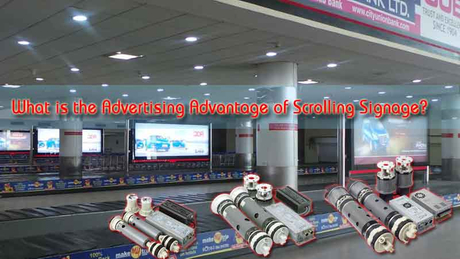
Drive motor: modern systems use a brushless DC (BLDC) motor. It holds constant speed under a changing load — the poster loop gets heavier on one roller and lighter on the other as it winds — and it runs for years without the brush wear that limits conventional motors.
Roller set: two or more tubes, one at the top of the cabinet and one at the bottom, that carry the poster loop. Their diameter matters: the larger the roller, the gentler the bend the print takes on every cycle.
Digital control board: the brain of the system. It sets scrolling speed, direction and how long each poster dwells in view, and it keeps paper tension at a fixed setpoint instead of letting it drift.
Power supply and timer: quality kits accept 220 V or 110 V AC, with a 12 V DC option for off-grid sites, and include a timer channel so the display can rest overnight.
Poster loop: the printed media itself — typically a backlit PET or paper strip, welded or taped into a continuous belt that threads over both rollers.
When suppliers sell these parts as one factory-matched package, the package is called a scrolling kit. When they sell a motor and controller from different sources, integration problems are the usual result.
The direct answer: the controller commands the motor to advance the poster loop by one panel length, holds it in view for a set dwell time, then advances again — a continuous cycle that shows every poster in sequence.
Step 1 — Advance: the motor rotates the rollers, moving the loop forward until the next poster is centered in the display window. On a digital system this position is measured, not guessed, so posters always stop aligned.
Step 2 — Dwell: the loop holds still for the programmed interval — commonly several seconds to a minute, set per campaign — while the backlit panel illuminates the poster.
Step 3 — Repeat: after the last poster in the loop, the sequence returns to the first. With six posters per side, one panel delivers a repeating six-advertisement rotation around the clock.
Tension control throughout: the controller regulates how tightly the loop is held. Too loose and the print drifts or wrinkles; too tight and the poster is stressed on every cycle. Digital tension regulation is why Adhaiwell states its system extends poster life two to three times versus traditional scrolling designs (operator-reported, not independently audited).
Synchronization: where several units run together — double-sided cabinets or a wall of panels — built-in synchronization keeps the loops in step, and some installations coordinate scrolling panels with adjacent digital screens for combined campaigns.
The whole mechanism has one moving assembly and no consumable parts except the poster itself, which is why the technology has stayed in service in city media for decades while electronics around it have improved.
The direct answer: because motion and multiplied inventory raise the earning power of a panel without the cost, power draw and permitting burden of replacing it with an LED screen.
Six slots on one panel: a static light box sells one campaign at a time. A scrolling system sells up to six on the same cabinet, structure and permit footprint — the three most expensive things to change in outdoor advertising.
Market tailwind: the World Out of Home Organization estimates global DOOH spend at US25.5 billion in 2025, rising to US28 billion in 2026. Advertisers increasingly expect movement; a scrolling panel offers it at print-media budgets. (These figures come from commercial research whose methodologies differ — treat them as directional context, not a forecast for any single network.)
Power discipline: a scrolling kit draws between 50 W for small panels and 220 W for the largest 6 x 3 m formats — figures most existing site connections handle without any electrical upgrade.
Print-format friendly: brand creative is still predominantly designed as posters. Scrolling shows that creative in rotation without asking agencies to produce video.
The direct answer: match the kit to panel area and poster width. The Adhaiwell SPDE range, manufactured in Shenzhen, divides into three tiers that cover nearly every street-media format.
Kit | Roller diameter | Max poster width | Panel area | Max power |
SPDE HW-51A / 51AE / 51AX | 51 mm | 2 m | up to 3 sqm (1.5 x 2 m) | 50 W |
SPDE HW-76A / 76AE / 76AX | 75–80 mm | 3.5–5 m | 6 to 15 sqm | 70–150 W |
SPDE HW-120A | 120 mm | 6 m | 12 to 18 sqm (up to 6 x 3 m) | 220 W |
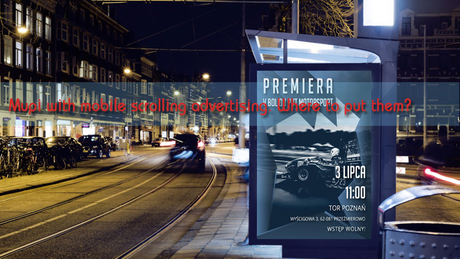
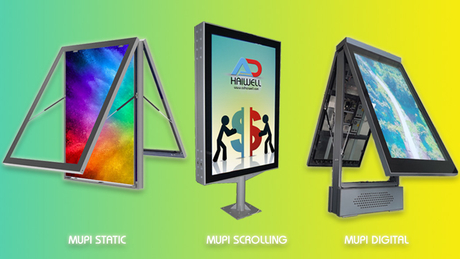
Small city light boxes and MUPI panels — the classic 1.2 x 1.8 m format — run on the 51 mm tier, where poster loops are short and light.
Street furniture and classic billboards from 3 x 2 m to 5 x 3 m sit in the 76A tier, the volume segment of the market; this is also where Adhaiwell's SPDE scrolling kit range publishes its full per-model specification sheets, which is the documentation standard to expect from any supplier.
Large frontage and gateway signs up to 6 x 3 m need the 120 mm rollers of the HW-120A, built for long, heavy loops. Few manufacturers in China produce scrolling systems at this size at all — it is the tier where factory track record matters most.
The direct answer: wherever the same audience passes or waits repeatedly — transit hubs, city street furniture and retail districts.
Transport hubs: waiting commuters see several rotations of the loop in a single wait, which is exactly the repetition advertisers pay for.
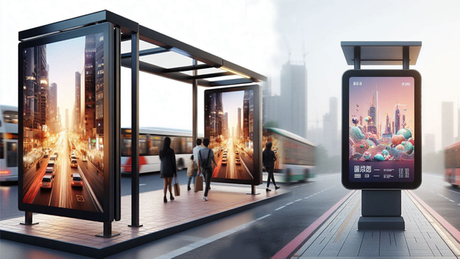
City street furniture: bus shelters and free-standing city light boxes gain motion while keeping their existing permit footprint. Many operators pair the drive kits with purpose-built multi-poster city scrolling light boxes so cabinet geometry and roller spacing are engineered as one piece rather than adapted after the fact.
Retail districts and malls: a shopper walking one commercial street past several scrolling panels meets the same campaign repeatedly — frequency that static display cannot deliver from the same sites.
Indoor and outdoor variants share the same drive architecture; outdoor cabinets add weather sealing, and rules on outdoor advertising structures and poster content differ by country and city, so confirm locally before a network rollout.
The direct answer: very little — poster changes, periodic cleaning and an occasional spare-part swap are the whole routine on a quality kit.
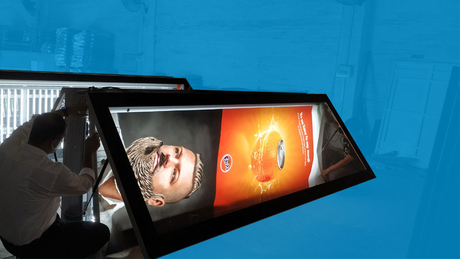
Poster changes: the only scheduled task. The loop is swapped manually by opening the cabinet; how often depends on the campaign calendar, not the hardware.
Inspection: check roller tracking and loop tension during each poster change. On digitally regulated systems, tension should not need manual adjustment between campaigns.
Spares: rollers, belts and controllers are field-replaceable modules. Contract a spares package with the supplier at purchase time — a panel waiting on a controller earns nothing.
Testing before delivery: ask any supplier for a documented factory burn-in; Adhaiwell runs every kit for 24 hours under power before shipment (operator-reported), which is the practice worth demanding across the industry. The SPDE scrolling poster display system kits built in Shenzhen ship with correct export classification under HS code 9405600000 — the same paperwork discipline to require from any source.
These answers come from the manufacturer side: Adhaiwell has built scrolling advertising systems in Shenzhen for more than ten years, supplying drive kits and complete light boxes for city media, transit and retail networks, with a 24-hour factory test on every unit.
How many posters can a scrolling display system rotate? Up to six per side on current SPDE kits. More than six shortens each poster's dwell time below what street-level readers need, so six is the practical ceiling.
Does the system need a special poster print? No — it uses a continuous printed loop in backlit media, produced to the loop length your panel requires. Any trade printer can supply it once the loop dimensions are known.
Can one system run both sides of a double-sided light box? Installations typically use one drive per face so each side runs an independent loop and can carry different campaigns. Synchronization between faces is available where coordinated display is wanted.
What happens during a power cut? The system simply stops and resumes its cycle when power returns; the controller remembers its program. No data, content or settings are lost because the "content" is printed media.
Is a scrolling system suitable for indoor use? Yes — malls, airports and showrooms run the same drive architecture with quieter settings and without weather sealing. Panel sizing works identically by area.
Let's light up the future of advertising together
Mon - Fri: 9 AM - 6 PM
Sat - Sun: 11 AM - 3 PM




 English