Views: 0 Author: Adhaiwell Publish Time: 2026-10-24 Origin: Site
Changing posters in a Mupi static LED light box takes about 30 seconds when the cabinet is engineered around gas-spring doors and rapid fixing clamps. That number matters more than it first appears. The World Out of Home Organization's 2026 Global Out of Home Expenditure Report puts global OOH spending at US$54.2 billion in 2025, up 15% on 2024, with digital out-of-home at US$25.5 billion — 47.1% of the total — and forecast to reach US$28 billion, or 49%, in 2026, when digital is poised to overtake static for the first time (WOO, 2026). Read the other way: static formats still carried the majority of global OOH revenue in 2025, and most city light panels on the street today will remain static for years. For media owners and outdoor advertising contractors, the economics of those static faces depend on how fast a crew can rotate a campaign. This guide explains the hardware decisions that turn a poster change from a two-person, 15-minute job into a one-person, 30-second routine — and what to verify before specifying a city light advertising billboard for a municipal or media-network project.
A full poster change on a Mupi static LED light box takes about 30 seconds, with one technician and no tools.
Hydraulic gas springs hold the tempered glass door open safely, turning a two-person job into a one-person routine.
Fluorescent diffusion cloth replaces the traditional milk-white acrylic backing: lighter, cheaper to ship, and more even in light distribution.
Rapid fixing clamps hold PP paper and backlit film without tape, pins, glue or clips.
Static street furniture still carries the majority of global OOH revenue; fast poster rotation is part of what keeps it commercially viable.
The hydraulic gas spring system lifts and holds the tempered glass door open by itself, so one technician can service the cabinet without a second person holding the door.
What that changes in daily operation:
One-person operation. A 1.2 × 1.8 m city light door with 6 mm tempered glass is heavy enough that a conventional hinged door needs one person to hold it and one to work. Gas struts remove the second role and the risk of the door swinging shut mid-task.
Balanced resistance over years outdoors. Quality gas struts hold their damping through tens of thousands of open-close cycles, which is the realistic service count for a panel on a busy transit street.
Safer in wind and traffic environments. A door that cannot slam is also a door that cannot trap a technician beside live traffic — a routine but real hazard on roadside street furniture.
Adhaiwell publishes the mechanical details of its Mupi static LED city light box — glass, sealing and door hardware included — on the city light advertising billboard product page, which is the reference sheet for everything described below.
Fluorescent diffusion cloth replaces the milk-white polycarbonate or acrylic sheet because it is lighter, cheaper to ship and distributes LED light more evenly across the poster.
The trade-offs behind that substitution:
Weight reduction where it matters. The backing sits inside the pull-down frame, so every kilogram saved makes the frame easier to lower and re-seat during each campaign rotation.
Better light transmission. A fabric diffusion layer spreads the LED backlight without the green tint and hot spots that thick acrylic panels can introduce, which matters for backlit film where colour accuracy sells the creative.
Logistics economics. For a 500-panel network, removing a rigid acrylic sheet from every cabinet also removes it from the shipping container — a saving that compounds across ocean freight.
Rapid fixing clamps grip the top and bottom edges of the printed media mechanically, holding the poster flat without adhesive tape, pins, glue or clips.
Why media owners switched to this fixing method:
Tool-free and reusable. The technician pushes the poster edge into the clamp and it holds; there is nothing to dispose of and nothing to run out of mid-route.
No wrinkles, no sag. Even edge tension keeps waterproof PP paper and polyester backlit film flat against the diffusion layer, which is what keeps the illuminated image looking uniform from the pavement.
Faster than any taped method. Because nothing needs to be peeled, aligned and re-taped, the fixing step collapses into seconds — the step that makes the 30-second total realistic.
The full sequence is: open the gas-sprung glass door, pull the internal frame down to working height, fix the new poster with the rapid clamps, and push the frame back and close the door.
The four steps in detail:
Step 1 — Open and lock open. Unlock and push the 6 mm tempered glass door; the gas springs take the weight and hold it open.
Step 2 — Lower the frame. Pull the internal fluorescent-fabric frame down to a comfortable working height.
Step 3 — Fix the new graphic. Seat the top and bottom edges of the PP paper or backlit film into the rapid fixing clamps.
Step 4 — Close up. Push the frame back into position and swing the door shut; the lock returns the cabinet to its sealed, IP65 state.
Across a campaign rotation of dozens of panels, the per-panel saving compounds: a crew that once budgeted 15 minutes per face now budgets under one, which is the difference between a weekend changeover and a two-week disruption.
Adhaiwell builds these cabinets to IP65 sealing with galvanized steel or extruded aluminium framing, powder-coated for corrosion resistance, and rated for −40 °C to +70 °C operation.
The specific engineering choices:
Enclosure and materials. IP65 sealing protects against dust and rain jets (the rating is defined under IEC 60529), applied over a galvanized-steel or aluminium structure with outdoor powder coating in any RAL colour to match municipal streetscape requirements.
Corrosion strategy for coastal cities. Anti-corrosion coatings and marine-grade stainless hardware are specified for high-humidity, salt-laden environments, which is where uncoated steel light boxes fail first.
Thermal and electrical protection. High-lumen LED backlighting with timer and light-sensor control reduces energy draw — Adhaiwell states a 40% energy-consumption reduction for the LED backlight versus the lighting it replaces (manufacturer-reported figure) — and sealed electronics stay protected through the full temperature range.
Certification baseline. CE, RoHS and ISO 9001 certification covers the cabinet line; buyers should still confirm which certifications the destination municipality requires.
Maintenance budgets deserve the same scrutiny as the sealing spec. Published cost breakdowns for outdoor LED billboards put annual maintenance contracts at roughly 5–10% of initial installation cost (LumenMatrix, 2026, supplier-published cost guide) — and while a static light box has no LED modules to replace, the labour share of a maintenance contract is driven by exactly the door, hinge and fixing hardware described in this guide. Hardware that shortens each service visit is hardware that shrinks that recurring line item.
For buyers weighing static panels against digital street furniture, Adhaiwell's comparison of static billboard and DOOH advertising ROI sets out where each format earns its keep, and the outdoor Mupi LCD digital signage display line covers the digital end of the same street-furniture family.
Sourcing directly from a Chinese manufacturer like Adhaiwell provides municipal projects and media networks with factory-level quality control, OEM/ODM customization, and export experience—Adhaiwell reports more than 16 years of OOH equipment manufacturing and delivery to over 80 countries.
What direct-from-factory sourcing changes for a buyer:
Customization depth. Stand base dimensions, housing colour (any RAL), visual size beyond the standard 1185 × 1750 mm format, and electrical specifications can all be tailored to a city's streetscape code and power grid — the kind of variation that trading companies pass through at a markup, or refuse.
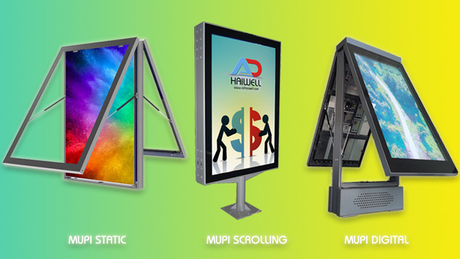
Format coverage from one line. Static, scrolling (up to 6 posters per side) and digital variants share the same cabinet architecture, so a mixed network can standardize on one door, one lock and one fixing system across every face.
Documentation for tenders. CE, RoHS and ISO 9001 certification, HS code classification (9405600000) and structural drawings are supplied as standard, which shortens the municipal tender paperwork.
When evaluating any supplier for a city light program, the checklist that matters:
Confirm the gas spring cycle rating and whether replacement struts are stocked as spares.
Ask for the door and frame weight — it determines whether one-technician servicing is real or marketing.
Verify the fixing clamp works with the exact media stock (PP paper weight, backlit film thickness) the network already prints.
Request the IP65 test basis and the corrosion specification for the actual installation climate, not a generic datasheet.
Check lead time and container loading for the full panel count, including spare doors and glass.
Static street furniture is not exiting the market — WOO's own 2026 numbers show digital only reaching parity this year, on a forecast. What separates the static panels that stay commercially healthy from the ones that lose contracts is rotation speed and maintenance cost, and both are decided at the factory, before the first poster is ever hung.
Adhaiwell manufactures static, scrolling and digital city light boxes in Shenzhen and supplies street furniture programs across Africa, the Middle East and Europe; the answers below come from that production and export experience.
How long does a poster change really take on a Mupi static LED light box?
About 30 seconds for a trained technician: open the gas-sprung door, lower the frame, clamp the poster, close up. The first change on an unfamiliar cabinet may take a few minutes; the routine time is what matters for network-wide campaign rotations.
Can one person service the light box without tools?
Yes. The gas springs hold the glass door open unaided and the rapid fixing clamps need no tools, so a single technician completes the full cycle. Conventional taped or pinned systems typically need a second pair of hands for the door alone.
What poster materials work with the rapid fixing clamps?
Standard outdoor advertising media: waterproof PP paper and polyester backlit film. Confirm the printed media weight and thickness with the supplier when ordering, so the clamp tension matches the stock the network prints.
Is a static light box still worth installing when cities are going digital?
In many cases, yes. WOO's 2026 report shows digital reaching only 49% of global OOH spend in 2026 — static formats still hold the majority of revenue and often lower capital and energy costs per face. The commercial case depends on fast, cheap poster rotation, which is exactly what this hardware optimizes.
What customization is available for municipal street furniture projects?
Housing colour (any RAL), stand base dimensions, visual size, single-sided or double-sided configuration, and static, scrolling or digital illumination — all specified per project against the city's streetscape and electrical requirements.
Let's light up the future of advertising together
Mon - Fri: 9 AM - 6 PM
Sat - Sun: 11 AM - 3 PM





 English